Author Archives: lifehomemade

Unknown's avatar

About lifehomemade

Moving from city life in Alberta to a Hobby Farm in New Brunswick. Starting the farm and learning along the way how to do it all from scratch.

The thing about sweet peas…

Standard

When I was a little girl, we lived in a rented house with a laundry stand in the back yard. Mom planted strawberries at the base of that stand and turned a broken terra cotta pot upside down in the middle of the patch of strawberries to encourage a toad to come to our garden. I used to climb the 5 or so steps up to the laundry stand and peek over the railing to see if I could spot that toad with a lovely home in the middle of a patch of strawberries. It was lost on me that we likely didn’t have a toad at the time the pot was over turned. We may not have had a toad for weeks afterward, but I was encouraged, every bit as much as our eventual toad was encouraged to be in that garden.
I don’t remember now, if I ever did find that toad for sure, but in my mind, he had a family and brought fat juicy slugs to his wife every evening at dinner time.

I learned from my mom how to be in a garden. How to plan for what will come, and how to be ready for what comes that wasn’t planned. It wasn’t until I was much older that I figured out how well that translates into life.

Mom taught me about sweet peas, too. She knew, like her mother before her, and likely her mothers mother, that planting sweet peas on Good Friday ensures a bumper crop of the tallest, most aromatic, multi-flowered stems. Even if it required the use of a pick-ax to break the frozen ground. Every year my mothers sweet peas were prolific, glorious clouds of perfection. Every year she would take bouquets to friends as hostess gifts, neighbors as friendly gestures, and family whenever she could. Every room would have a small vessel of sweet peas to brighten it, all summer long.
And although this little pearl of wisdom wasn’t really about how you should live your life, it was about living it beautifully, and with grace. And that’s the thing about sweet peas.

Beginnings, middles and endings…..

Standard

My dog is lying on the grass at the bottom of the porch stairs. The spot she chose is still straw-coloured from winter, but the sun is warming her as she lay on this bare patch of grass.
We have a high today of 11 degrees celsius. The buds are on the trees but no leaves as yet. Not much in the way of flowers. Just yellow-brown grass and sunshine, but it is a beginning.

I love beginnings. Beginning a new book, the first chapter especially. Beginning a hot vanilla lat­­e` or an adventure. The start of a long walk or a drive somewhere. The first 30 seconds at the dog park when the realization hits, the leash has been removed. A friendship. A romance. A marriage.

The middles are alright, too. I like the comfort of middles. The relaxed atmosphere of being here already for a while and there’s time still. Like Saturday mornings, or finishing a friends thought and laughing with her because you understand. Middles are good.

Endings, I like, because it means there will be a beginning again. And because endings mean rest, renewal, and regeneration.
My dog found a warm place in the sun. She stayed for a while, enjoyed the comfort and the warmth that came from being there. Then I called her inside, which ended her warmth. And I gave her a treat – the smelly liver flavoured kind – which then started something.

Today I am thinking about beginnings, partly because of the weather and my dog, but mostly because I’ll be heading the the farm in a little over two months. I’ll start packing at the beginning of June and this time will be taking anything I don’t use often but want to keep, and all my summer clothes, because the next time I head there will be when I move, at the end of June 2013.

I am thinking about middles because, to be truthful, this dream began when I was twelve, began again when I was 43, and again after I met my love at 44, again at 46 when we bought the farm, and every day since beginning again with each evolution into its’ current-rough-draft-of-a-farm.

I am thinking also about endings. We have friends here, and family. I have a home that I bought eight years ago when my son was only 2, and my dream of home ownership as a single parent was almost outside my grasp. I was house poor for ages to accomplish my wish to have each of my kids in their own room. And in the nick of time, too, as my eldest went away to university the following year.
There are memories here, more than anywhere else in the last 25 years. I will miss it. I will miss the 7 faces of my garden, as it was re-done year after year. I will miss my neighbours (well, most of them) and the kids I’ve watched grow up from birth; my sunny kitchen, the ease of the gas fireplace.
I won’t miss the fuel cost for the fireplace or the electricity, water, & sewer combined costs, the Trans Canada Highway just down the block with it’s accompanying noise, dust and grime covering every surface daily, the organic market prices, the tiny pantry, no kitchen storage, or the front door that doesn’t close properly.
So I tell myself, I can visit friends and family. They can visit me. And this ending isn’t sad at all. It’s becoming a beginning again.

The Wedding

Standard

So I haven’t posted anything about the wedding yet.
I had hoped we would be able to have it at the farm, outside, with guests perched on quilt covered hay bales on either side of a petal covered isle, leading to an alter, with an officiant covered in white robes….but we are still miles away from having comfortable spots for guests to sleep, as well as a decent place to cook for more than 10 people. Wouldn’t it be grand, though, to have some kind of celebration there for our tenth anniversary? Maybe that will have to do.

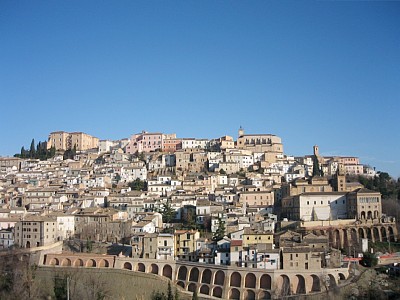
Enter Loreto Aprutino – A tiny town in Italy, only 30 kilometres from the coast, and roughly 2 hours from Rome, is the magical spot chosen for our wedding.
The bride will be dressed, unconventionally, in fuschia and white with white peony’s and a modest veil; the groom in (of course…) an italian suit, looking every bit the Sean Connery stunt double. There will be photo’s taken outside the town hall, and on the beach and in the cafe and ….. and…. and…. yes, there will be photo’s!
In just under a month, I’ll be there, with my sweetie and my world will begin again. A new chapter that I am excited to read in this book I can’t put down.

After our trip, we’ll be getting ready for our journey east once more. Back to the farm for the summer. Building fences, enriching soil, mapping future pastures and starting construction on the house.
I have been making lists for weeks now, and have narrowed down the tasks at hand, counting back from departure date to now, the things that need to be done. My plate is full, but I like it that way. I can feel the bubbling anticipation and it’s hard to sleep.
Tomorrow is Easter. I have an easy plan for the day. A drive in the country, toss around a glider in the park, pizza and a movie, then sleep. Monday the countdown begins. I’m ready.

I miss my tractor…..

Standard

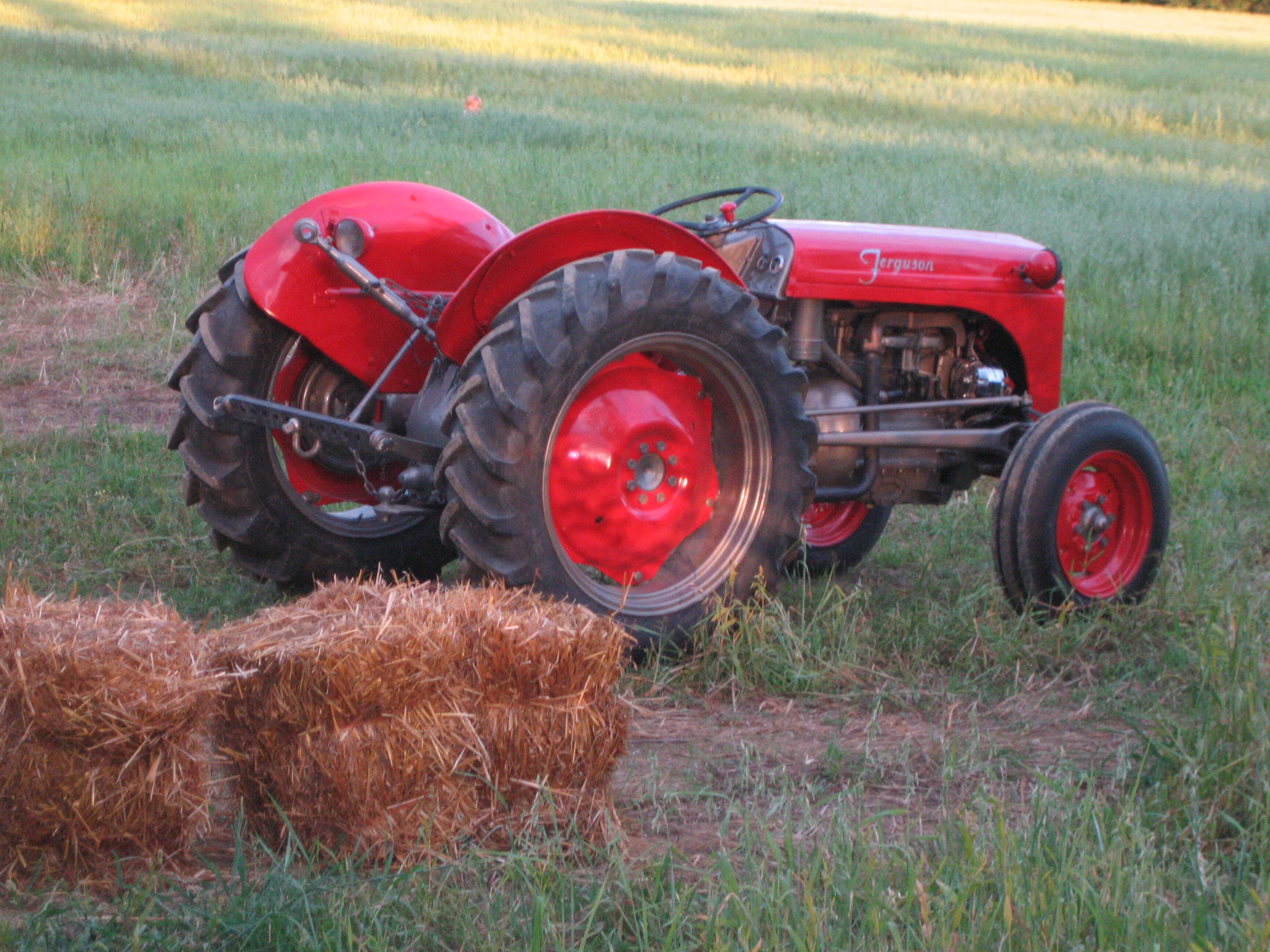
1951 Ferguson Tractor - the pre-curser to the Massey Ferguson. Man oh Man, I love this tractor!

How is it possible that this born and bred city girl misses her tractor?
I have only used it maybe a dozen times, constant learning curve, all the while my stupidly long legs – the right one specifically – having to bend in weird angles to get the extra stiff clutch to move. Yes, it is a bit of a pain to drive – but WOW! is it beautiful!

It’s home is in New Brunswick, and until the move, I am in Alberta, biding my time, researching all that can be researched about farm animals and growing things. The weather here has been beautiful. The ground is thawing and the buds are on the trees. In New Brunswick it has been about 10 degrees warmer with rain and things turning green. If I were there, I’d have started seeds in the as-yet-to-be-built greenhouse, ordered saplings for planting along the road, and started on barnyard fencing. My beautiful tractor would have started the season with a tune-up and a drive around the fields.

Now, I know that “beautiful” isn’t what farming is based on. I also know that you can produce perfectly respectable, wholesome, natural, GMO free, additive free, hormone free, organic food with an ugly tractor…. or no tractor. But the fortunate opportunity to be able to choose a beautiful tractor to help with the occasional tilling or plowing or pulling before we have found a willing draft horse, presented itself two years ago. I didn’t know the first thing about tractors, but as usual, my gut served me well. I bought it, and the lovely farmer who restored it delivered it to our farm the following evening. Parked it right in the field so I could practice a while before it got dark. He even put some gas in it for me.

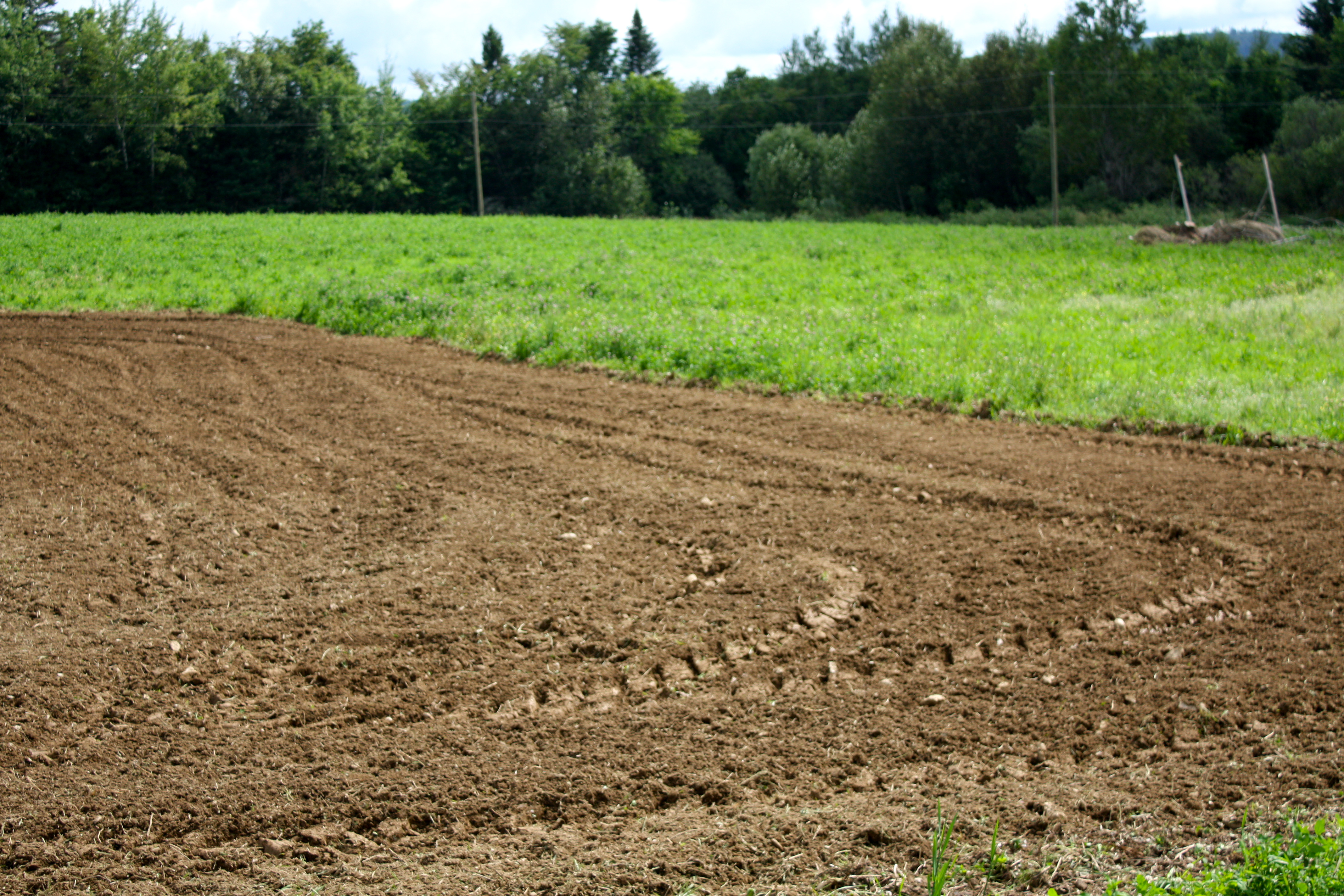
This Ferguson has been lovingly restored. It runs beautifully and has been cared-for well. Last summer, we used it to till up the market garden. It was to be 100’x100′ but after 3 hours and some (make that a lot) extremely large rocks were hit by the tiller, and didn’t even budge but had huge gashes in the sides of them along one side of the garden – I decided to be happy with 100′ x 50′ for the first few years. Then I will expand in another direction to save my tiller.

So, as mentioned the tilling took three hours. The rock pulling took three days. I told my son he could make a nickel for every rock he pulled out of there that was bigger than his outstretched hand. It was a hot few days and he worked and worked until I owed him $30.00! I figured, after that, what rocks were in there, could stay in there.

I really think I may be growing rocks. Hope there’s a market for them.


This tractor may help with putting a fence around this market garden. It has a three point hitch and power take-off. I hear there is a power auger that can hook up and dig post holes. It will help with delivering manure from the far side of the barn to the compost heap, then from seasoned compost heap to the garden bins where it will be stored until used. It may even help haul some of the harvest from the pumpkin patch. It may be used for hay rides in the summer, tours of the farm, to bring bales to animals or haul water to the pigs in the lower pasture. It will save my back and help me complete work a whole lot faster.

So although it is a beautiful tractor, it’s not just another pretty face.

Clover Hill Heritage Farm Photo’s

Image

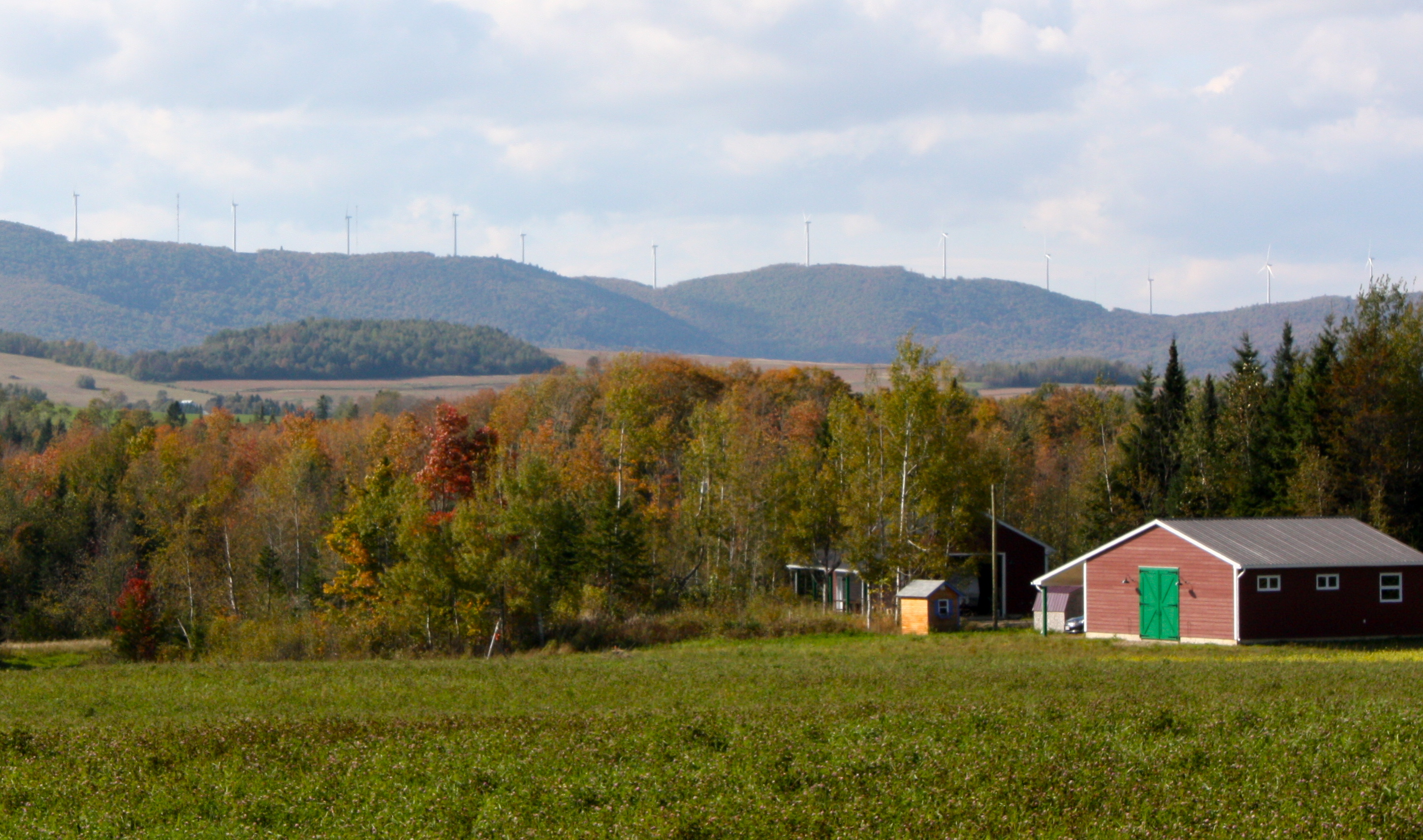
Mars Hill wind farm,in Maine, can be seen behind us on the ridge. You can make out sticks on the top of the hill that are the windmills.

As seen from our field, this is the barn, built last summer, but the photo was taken in October when the leaves were changing. Behind it you can see through the trees, is the workshop built the year before.

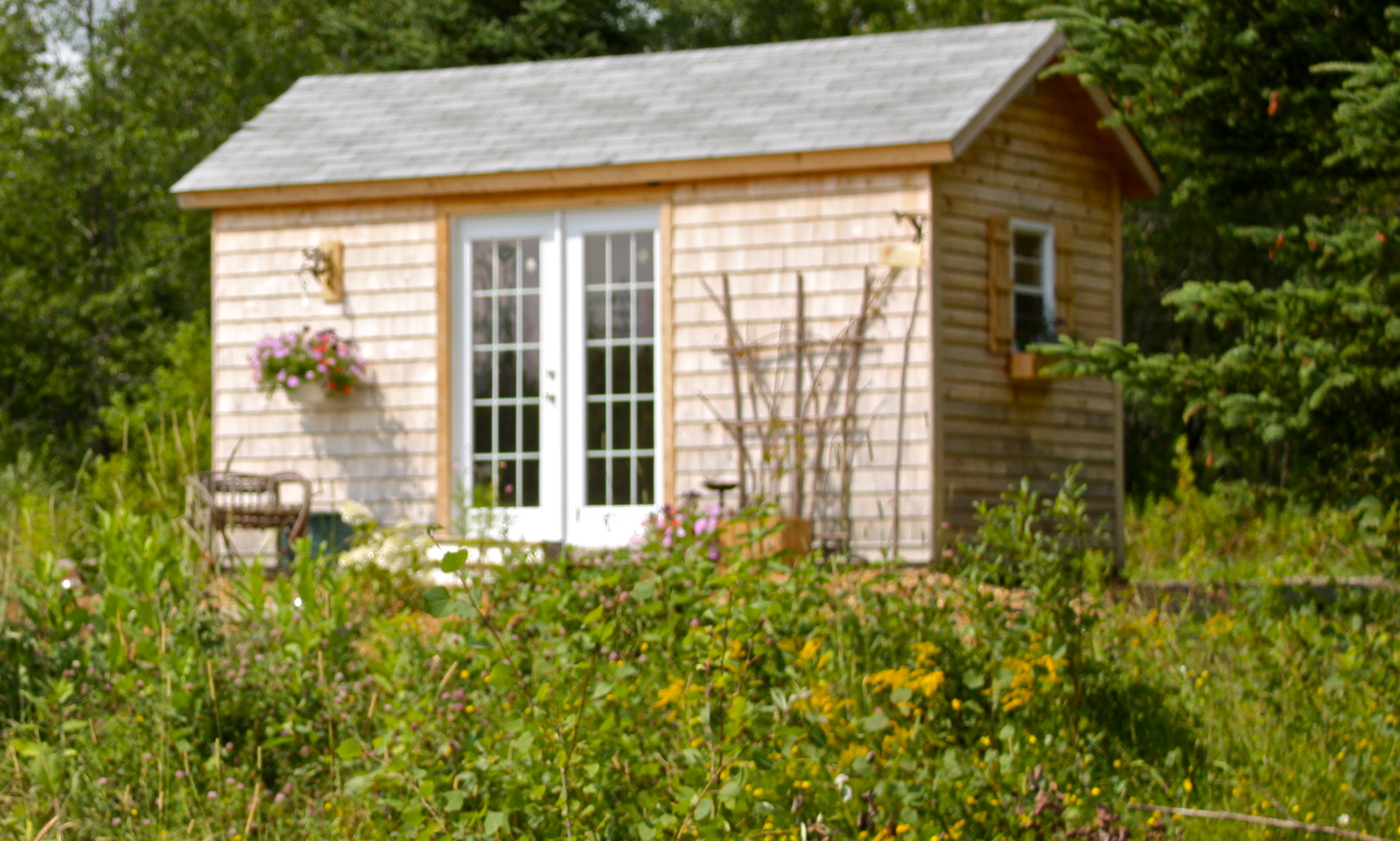
This guest cottage only had two guests last summer. (it didn’t get finished until August) I hope it gets more use this summer. Great for sleeping when the nights are cool, but it sits out in the open, alongside the orchard and heats up during the day – making it quite stifling midday. Maybe we’ll get to insulating it at some point to make it comfortable no matter the time of day. It needs a coat of paint or stain, and a shade tree beside it. It keeps the rain off and the critters out, though.

I loved the whole process of setting up this little cottage. This one was built off farm, and delivered to us on a flat bed truck. It was amazing watching it being pulled off the truck and slid to the level spot chosen for its' view. The next few will be built by us, a little bigger, hopefully, with room for a small fireplace or cookstove, and perhaps we'll get creative with outdoor solar showers, or in-ground bath-tubs! I would like to make a spot for a fire pit to set up a tri-pod and chain to hang a cooking pot. Maybe set up a little oasis back there for private morning coffee. As with everything, the ideas are evolving.

This Coop is 8' x 10'

The chicken coop window boxes

The chicken coop was more or less finished in 2010. It’s been painted, had flowers planted around it, but the nest boxes aren’t done and neither is their screened-in-run. They will free range, but I want a place for them to go to hide if there are hawks, eagles, racoons, weasels, or any other predator that loves the taste of chicken. It’s large enough for 15-20 chickens (although I will likely only have a dozen) and has a spot that would work well to place a brooder. It is tall enough to place a small loft for feed storage, too.

The window boxes have some kind of ornamental pepper in them and another kind of draping annual of which I don’t know the name. I got them from the garden centre and thought they were pretty. I’ll plant seeds in there before the chickens come, and they will be pansy’s and stocks. The perennials along the side are Monkshood, Lily, Delphinium, and Cranes Bill geranium.

Some of these flowers aren’t good for chickens, if they eat them, so they will be moved in front of the house when it is complete, or donated to a neighbour who doesn’t have chickens. The screened in part will be at the back, away from the window boxes and surrounding a walnut tree there.

Corn brooms

Standard

I have already acquired heirloom varieties several hard to find vegetable seeds and will germinate some this summer to see if they are viable, and save this years seeds to plant next year. I have read that heirloom seeds (depending on the species) can last up to three years and still be viable, but I have actually experimented with several seeds over five years old and still had more than a 50% germination rate. Some of my seeds are quite rare, though, so I don’t want to mess with best before dates and risk losing them entirely. Once I get to the farm this year, I will do a complete inventory of seeds and figure out what needs to be added.

Earlier in the year I spoke to a man in Colorado who has several pounds of broom corn seeds that he wants to trade for a seabuckthorn tree. I have to admit, I was tempted to send him one in trade for the broom corn but didn’t because I know across border shipping can be tricky and I wasn’t so sure he wanted me to get into the paperwork for exporting live trees. I thought it would be less fun, but more practical to just purchase broom corn seed.
I have a homemade corn broom that I love and thought I might try my hand at making a few more. If I understand it correctly, you plant the broom corn (Sorghum vulgare) and the seeds grow at the end of some pretty sturdy stocks. You cut the stocks, remove the seeds and bind the stiff grass type stock with twine to make your broom. Check out Youtube for how to make corn brooms.
The broom corn comes in a variety of colours, too, so you can make some really pretty, natural brooms.
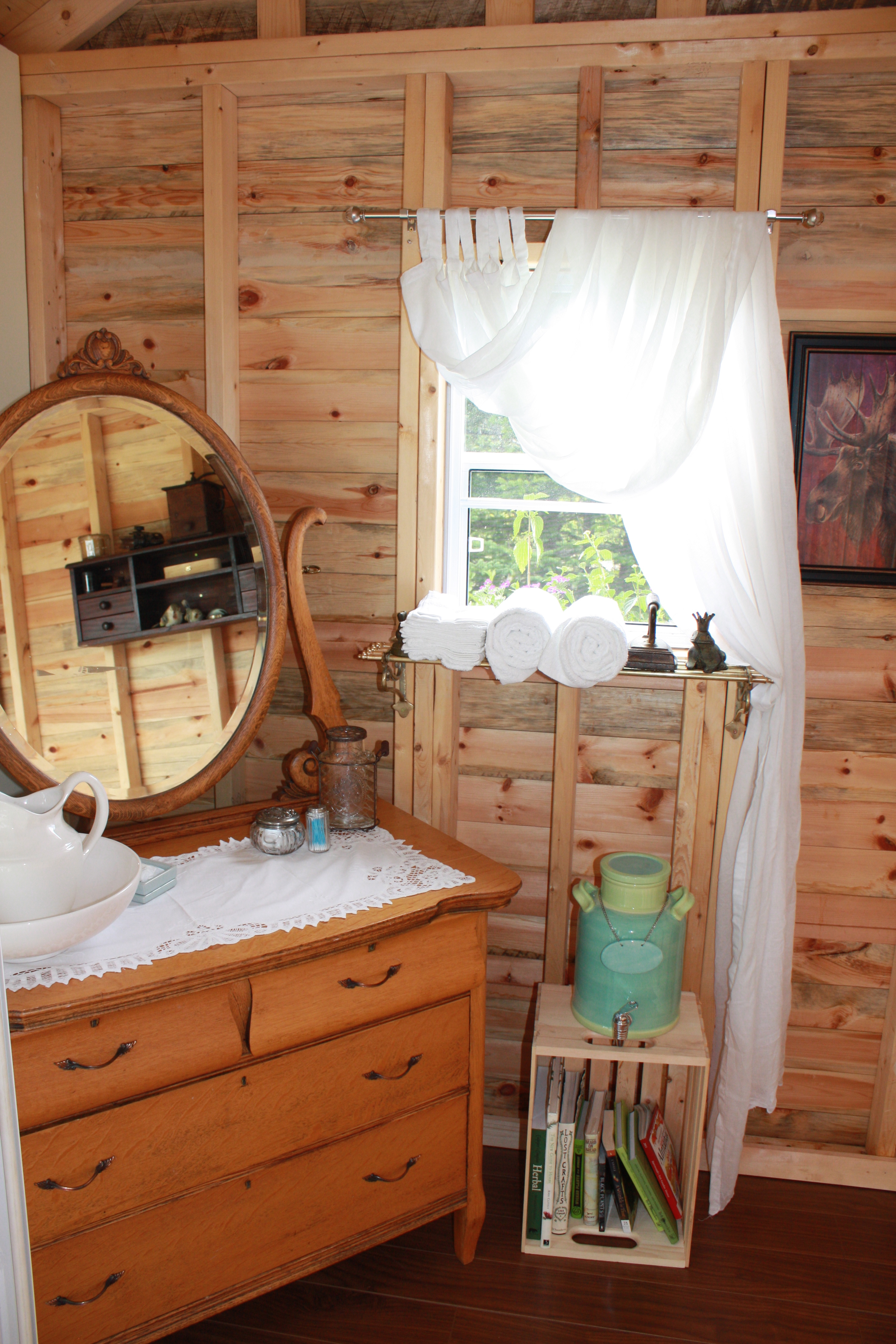
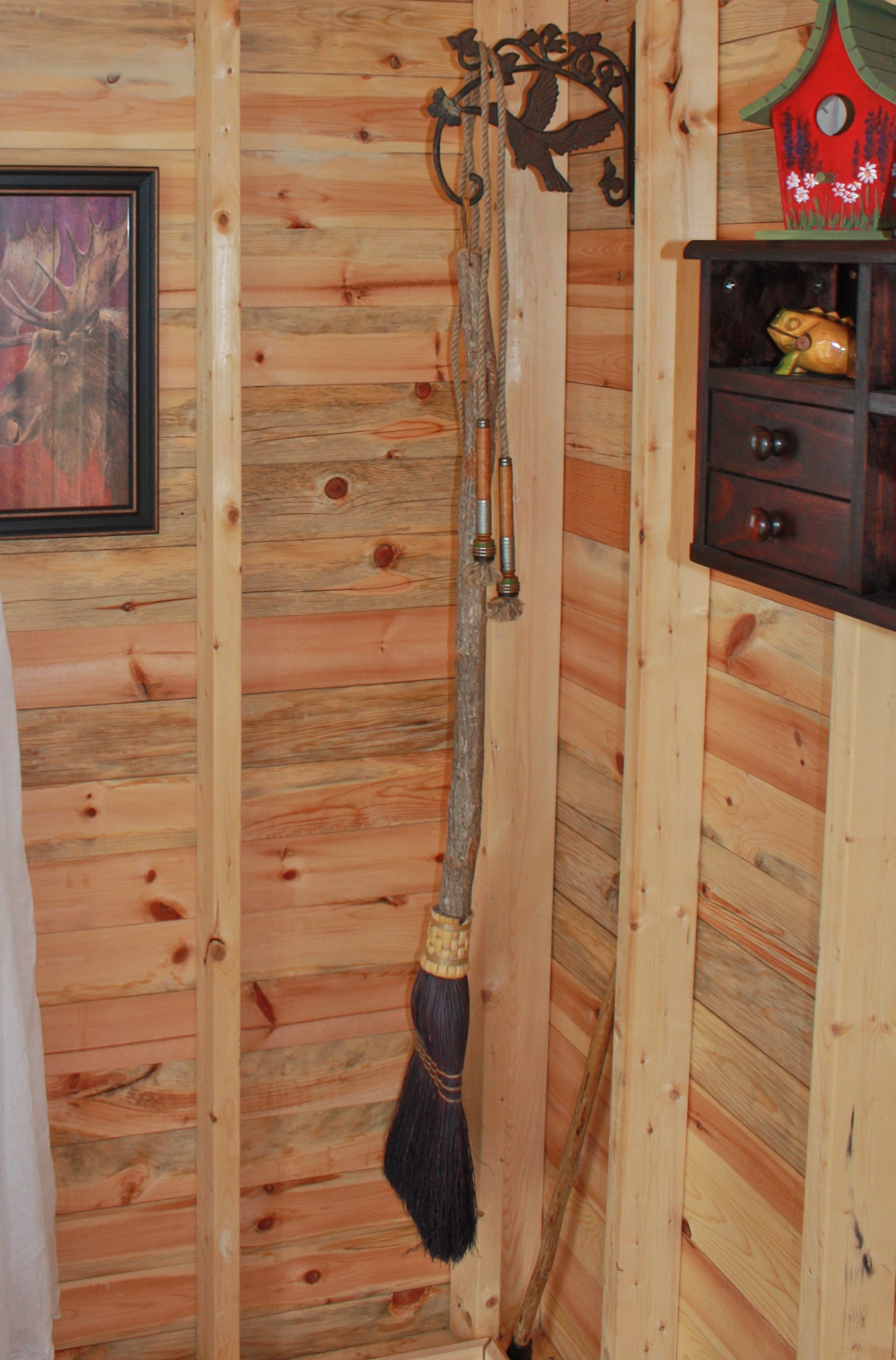
Here is a picture of mine in its’ spot in our little guest house…

Farm name chosen !

Standard

Bouncing about with farm names for the last few years now, and it turns out we have one that works. CLOVER HILL HERITAGE FARM specializing in heirloom varieties and heritage breeds.
I like the feel of that. So when we have our goat herd or our sheep flock they will be registered to our farms name when born. A baby goat born at our farm will be named, for instance, Clover Hill Adam (if we are having our “A” year) or Clover Hill Zola (once we’ve been doing it for 26 generations). Some farms do it this way to easily keep track of the year a goat was born. I don’t know if there is another reason for it – there may very well be – but I suppose I will find out soon enough.
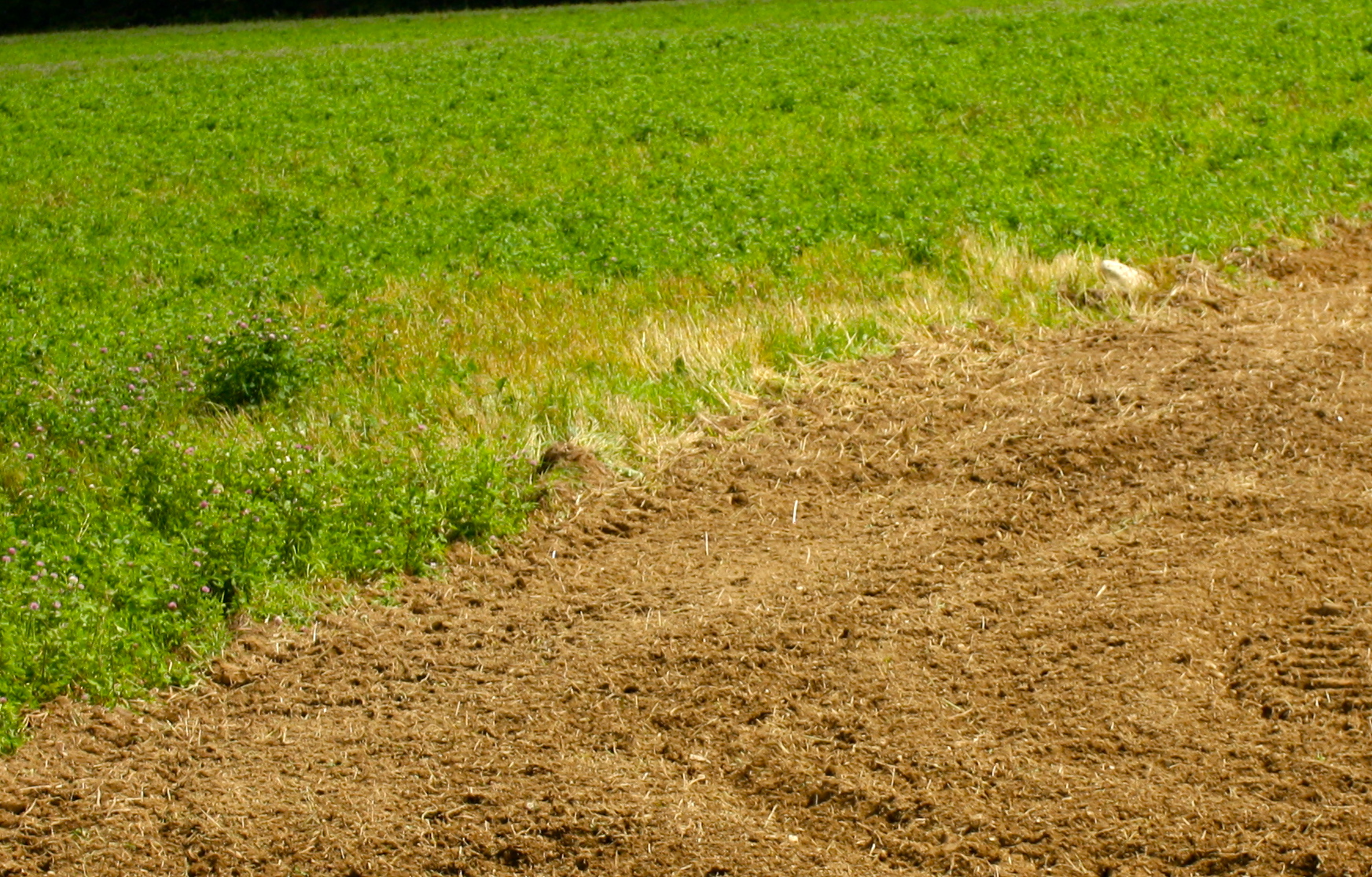
Our huge field (about 30 acres) along side our driveway heading up to where the house will be is covered in timothy grass and red clover. In early June, when all is in flower, the scent is intoxicating. And although that field won’t always be in clover, we will have it planted somewhere because our own clover, timothy and other grasses will be baled for winter feed for years to come, I’m sure.

Back at it…

Standard
Back at it…

It’s been a long while since I posted anything. But today, spring is definitely in the air! I am energized! The sun is shining, I have music rockin’, and I’m supposed to be cleaning out a closet, so of course – now is the perfect time to write.

Looks like this summer we will be breaking ground on the house. I am so excited about this particular part of the development for several reasons, not the least of which is progress. We bought the property 5 years ago thinking that in 3 or 4 years we would be able to move. So, 5 years later and looking at a few more years before the transition, could look like somewhat of a disappointment. But it’s not. This dream has evolved drastically in the last 5 years. We have started down a few paths, planning the farm, that made sense until we really did our research. Now, I am confident that when we arrive and dive into the market garden and filling the barn with small animals, the choices we have made are the right ones for us. It is easy to see why some new farmers can get so overwhelmed. I was, and I wasn’t a farmer yet.

Every summer at the farm starts early in the morning clearing, checking, mapping, repairing, building, moving, planting, and ends late, exhausted. This summer we have barn stalls and fences to build as well as starting work on the house. I am reluctant to plan any more than that given that last summer we felt obliterated by the end of it. I would love to have some time to have my sweetie hang out in his hammock and strum the banjo for a while. Oh, Lord, love that sound!

More decisions have been made about livestock. We have determined which breeds of animals will start on our small farm, and all for specific reasons.
Orpington chickens are the breed of choice because they are a heritage breed that still knows how to forage for food, set chicks, and be around people without being terribly flighty or aggressive. They are considered a dual purpose breed since they produce a respectable meat bird and lay eggs on a fairly regular basis. With the proper lighting in the coop, they may lay all winter. But, honestly, I like them because they are really, really pretty!
You can have a look at a really nice one here http://www.countryfarm-lifestyles.com/chicken-breeds-eggs.html

I have located a farm that will sell me hatching eggs of some of the nicest quality birds I have seen. That sounds like fun, huh?

Also located breeders for alpine goats in New Brunswick and nubian goats in Quebec, so shouldn’t have to go far for some quality herd sires and does. Alpines and Nubians are both dairy breeds of goats, and produce enough milk to make cheese and soap. They are playful and sweet and I can’t wait to have goats!

I have been in touch with a few sheep breeders and one in particular that works with icelandic sheep. I have been following this breed of sheep because of what I have read in ‘slow food’ circles and there seem to be a bunch of foodies that prefer icelandic sheep. Their meat is beautifully marbled without being fatty, mild in flavour, and the sheep are small enough to be handled for shearing without too much difficulty. Their fibre is lovely for spinning, too.

I hadn’t initially thought about having pigs, however I do love bacon! The more I learn about pigs, the more I want to learn about them. It seems that the difficulty in raising pigs comes from confinement issues that wouldn’t arise at our farm. We have a lovely sloping spot with ancient apple trees flanking the edge of the forest as it opens to a small meadow. Perfect for pigs to find shelter under the trees, and wallow in the little valley created by the convergence of two hills. There is a spring pond there until August most years. So, we are torn between Tamworth pigs, which are easily attained in the area, and Guinea hogs, which aren’t. I would prefer Guinea hogs since they don’t get as large as the Tamworth and would be much easier to handle for a first time pig farmer. Maybe I’ll turn up a breeder in the area. Keep your fingers crossed – grass fed pork is delish!

After a few years of cheese making and soap making and getting used to the farm schedule, I hope to have time enough to add a cow or two. I am thinking about scottish highland cows because they are extremely hearty and can exist on low quality pasture (not that ours will be low quality, but it may take a few years of pasture management to improve the soil quality) They are smaller in stature and have wonderful furry faces!

Add to these a few geese, ducks, turkeys and maybe a draft horse, and our small barn will be full. In a few years, we’ll have our schedules down, the market garden in full swing and sippin’ sangria on the porch at sunset.(that is, after we lock up the chickens so they don’t get eaten by foxes, called in the sheep and goats, milked the goats and cows, added bedding to their stalls, fed everyone and closed all the gates – ya,…. then, sangria on the porch… while snoring.)


Long winter….

Standard

Usually through the winter I try to fill my time with things that keep my mind occupied and creativity flowing. I had a few projects this winter that came upon me on a whim and turned out not too bad.
I made dolls for the first time and had a blast with those. They needed hair and dresses and jewelry, of course and I had fun imagining them in their adoptive homes with my nieces.

I made pies, bread stix, ice cream, gifts, gained a few pounds, and made it through another winter as easily as if I had indoor plumbing, electricity, and close proximity to the grocery store(which I do). Yup, gotta admire those who accomplish more than that without it!

Getting on with it…

Standard
Getting on with it…

The first few projects had some snags, but in the end, with trial and several errors, have worked out quite well. First – the adobe oven.

This was the first attempt at building a structure of this type and although there was some pretty heavy lifting, it wasn’t hard to do. We discovered three huge rock piles on the property. Two of them are on the other side of the road, but one is right here by our big field. Farmers have been pulling rocks from this field for many, many years and I don’t think we are done. This field, as many others do, seem to grow rocks like potatoes. I figured it was good to use some of those.
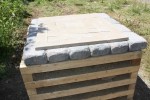
First, the base is made by stacking 4″x 4″x 4′ posts in a square on a fairly level base of gravel. I drilled holes in the corners and stuck some re-bar in there to hold it steady for the next step. I made our 3.5′ high because we are tall people – you may want to make yours shorter. The thinking is, when you spend three plus hours heating it up for use, you may want to use it for several baking projects, like breads first, then pies and pastries, then roasting meat and vegetables as the oven cools some. So if you are using the oven all day, you don’t want to be bending over to use it. Keep this in mind when building yours.
Then we filled it full of large rocks – the ones we found in our pile. Some of those were as big as my head! So this is where the heavy lifting came in. Luckily we didn’t have to cart them far, just into my wheelbarrow type trailer that attaches to my little tractor and then out again at the oven site.
Then we got out our shovels to cover the bin of rocks with dirt. We used twigs to poke down between the rocks to make sure it was shifting all the way to the bottom and just kept adding dirt until we felt it was sturdy.
Next, after making sure it was pretty level (Rob hates it when I tell him I ‘eyeballed it’!) we covered it with a layer of sand to make a flat surface to lay the bricks. We chose heavy flagstone for our first layer. Then another layer of sand, mostly to fill in the cracks and prevent any shifting. We dusted the top with more sand to give some security to our firebricks that come next.

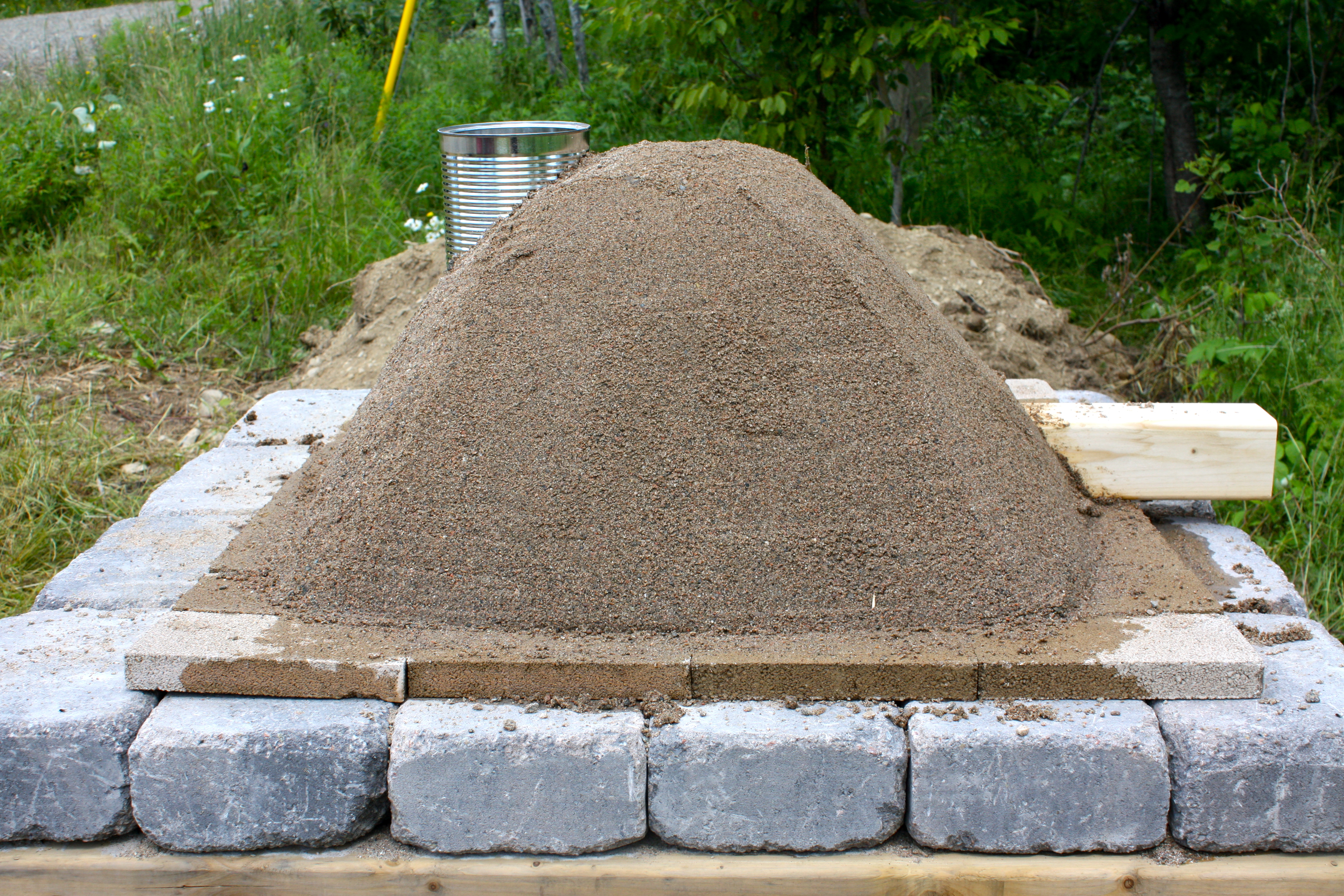
Base with the top layer of fire brick on - ready for our sand form

Then came our sand form.
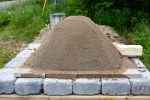
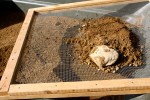
The sand form is needed to support the clay walls while the clay is wet. I made this sand form a little small for what I wanted, but at the time it looked almost too big. The sand is quite wet – a little wetter than you would use for a sand castle at the beach – only because you need it to get tall and the wet helps that.

Sand form for adobe oven


The sand form is then covered with newspaper. This is not really necessary for the structure, but it sure does help when it comes time to hollow out the sand. You stop scooping out sand when you reach the newspaper. It is also not necessary to remove the paper as it will burn off in the initial fire. Another tip: it is much easier to cover it with wet newspaper. The dry will fly off in the slightest breeze and make layering it next to impossible.
Now you have a good solid base for the clay.
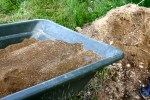
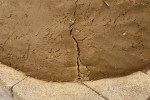
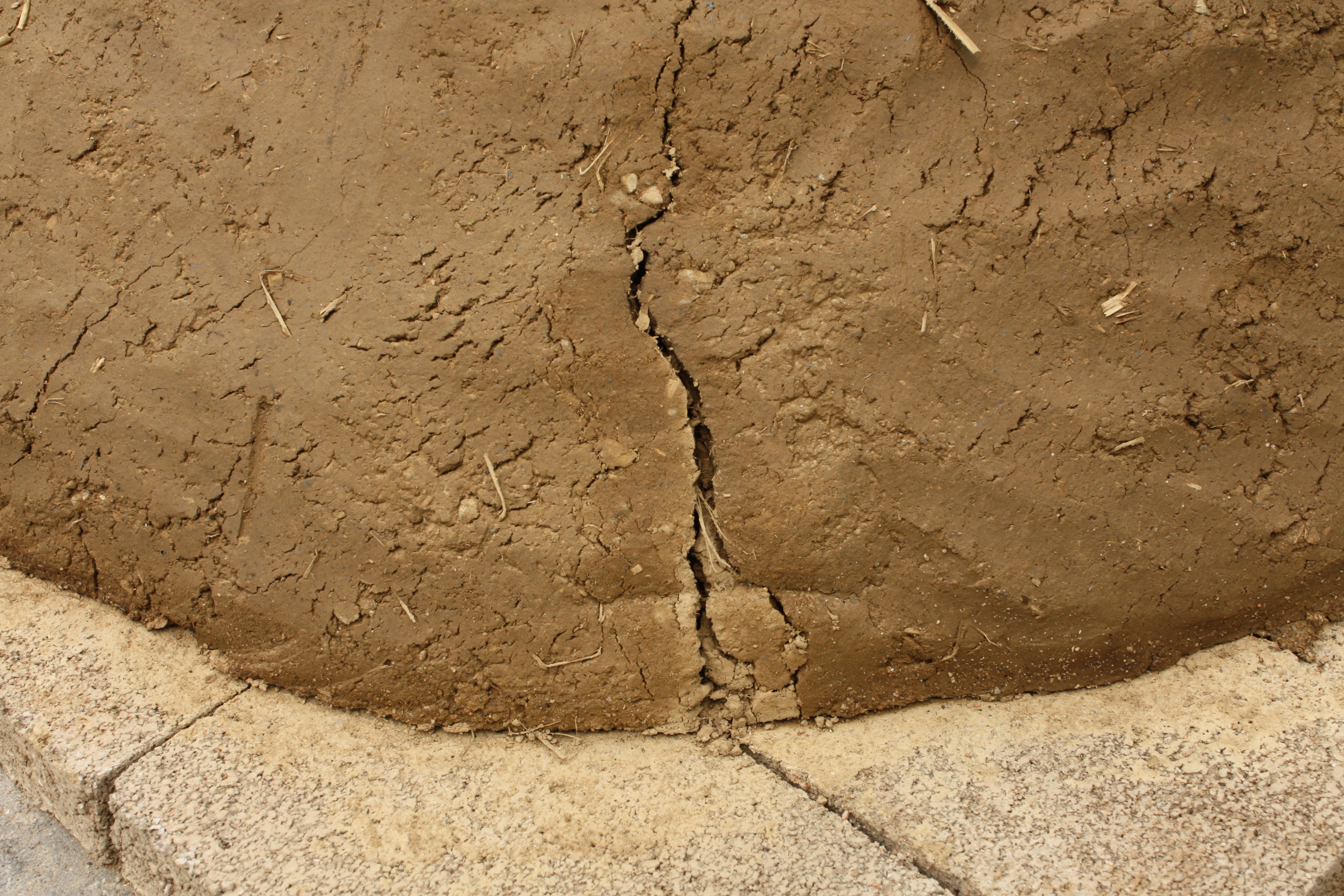
Our soil has a high clay content so using our clay was a no brainer to me. It stuck together well when moist and I initially thought there was enough sand in it to prevent cracking during the drying process. Turns out I was wrong about that, but the clay was terrific! Next time, I will mix 1 part sand to two parts of our soil and it should solve the cracking problem. A few of our drying cracks were just superficial and not at all harmful to the structure of the oven itself, but two of them were quite significant. These two had smoke coming out of them. Also, after having a few curing fires in this lovely oven, I have decided that the walls aren’t nearly thick enough. They are roughly three inches thick and I believe four and a half would work much better. The walls need to be thick to hold on to the heat for hours at a time. Mine are cooling too quickly, making a constant temperature inside the oven somewhat of a pipe-dream.

There are two of these cracks that threaten the integrity of the oven


Anyway, I’ve gotten ahead of myself. The clay we used was mixed with a three gallon bucket of straw cut up into finger lengths to help bind it together after it dries, then with enough water to make it like mud. It felt really good to get in there with my feet to mix it around, but not as effective as using a shovel and turning each scoop back into the pile.
I added the clay to the base starting at the bottom and working up. I made sure the first layer had lots of texture so that the second layer would have something to grab onto. Three layers later, I cut out the door. This is our final view before I hollowed out the sand.

Decorations attached

Now with the sand still in there, I let it dry for three days with a tarp over it to prevent sun from beating down and evaporating the water to fast. Then hollowed it out and another three days of drying under a tarp. The cracks were really tiny then and I tried to patch them before we lit our first fire. Unfortunately, they were too severe and shrunk up a bunch to make these large cracks. The cracks didn’t effect the size of the fire, though. It burned beautifully!

Nice fire!

So, to recap, I loved the process of building this fire. I am either going to tear it down and build another, taller, with more sand in it and thicker walls, or I will repair this one. I am thrilled with the way the inner walls turn a lovely terracotta pink after a few fires. I will, either way, be building more adobe ovens, and will definitely be baking bread in them.